
Inside the Plymouth County Most Wanted Program
Plymouth County has no single most-wanted list. The sheriff posts no public most-wanted page, and no countywide poster series covers every town. Instead, the wanted work here is split by agency. Each office runs its own program with its own scope and its own way to report a sighting. So a reader hunting for one Plymouth County warrant list can come up empty and wrongly decide nothing exists. The programs are real. They simply follow agency lines rather than county lines, and an outstanding warrant shows up in whichever office holds it. One caution: a curated poster is a selection, not a complete list of every open warrant.
Plymouth County Most Wanted Versus State Lists
The State Police program centers on serious crimes, so its selection rule is much narrower than a court's warrant file. A bench warrant in Plymouth County can follow one missed traffic date. A poster spotlights a far smaller group.
| Point | Statewide Most Wanted Program | Court Warrant Record |
|---|---|---|
| Who assembles it | A state police unit for serious fugitive cases | The court that issued the warrant |
| How it is chosen | A curated selection from serious investigations | Every warrant entered in the system, whatever the charge |
| Who can change it | The publishing agency | The issuing court, by recall or default removal |
| What it tells you | That a public appeal is open | Whether a specific case shows a default or warrant |
Treating one list as a stand-in for the other gives a Plymouth County reader nothing useful, because the two answer different questions.
How Plymouth County Most Wanted Lists Work
For Plymouth County, several wanted lists exist and none is run at the county level. Each state agency publishes and refreshes its own page on its own schedule. None posts a public update calendar. Those pages can also lag behind the court. Someone dropped from a poster may still have an open case. Someone pictured may already be in custody. Neither page decides a case. The record that answers the warrant question sits with the issuing court division, confirmed by its clerk. A Plymouth County resident with a real stake should call that clerk rather than trust a poster in either direction.
Safety Rules for Plymouth County Wanted Lists
The State Police most wanted page carries an explicit instruction to take no action on your own. That warning is not boilerplate. A sighting is information, and acting on it in Plymouth County puts bystanders at risk.
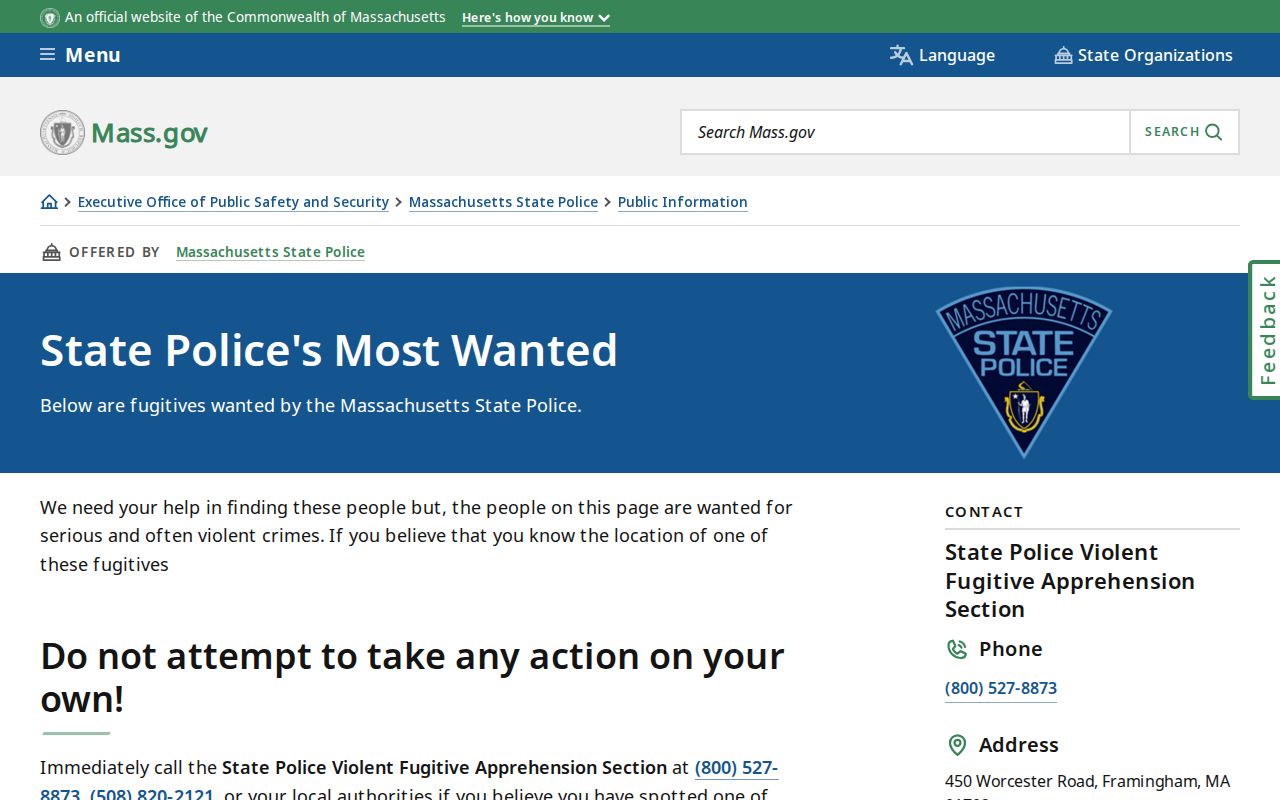
The State Police most wanted page posts that warning right beside the reporting numbers, which is where the instruction belongs. For anything urgent in Plymouth County, call 911. Never follow, confront, or detain someone you believe is wanted. Do not post a location publicly either.
Plymouth County Warrants and Parole Records
Parole warrants run on a separate track. The Massachusetts Parole Board operates a Warrant and Apprehension Unit and publishes its own route for reporting a wanted parolee. That program is not the court's warrant system, nor is it the State Police fugitive list, and a reader in Plymouth County should not blur the three. A parole warrant concerns someone under parole supervision, and the supervising agency controls the status. The parolee information page is the right channel. The same rule applies there. Report, and never approach.
Sending a Most Wanted Tip Safely
A tip is a short report of what you saw, where, and when, and it should stick to what you know rather than what you guessed. Leave the guesswork out. Give Plymouth County investigators the location, the time, and a plain description, and let them decide what it means.
Violent Fugitive Apprehension Section
The State Police unit that handles serious fugitive cases and receives tips about the statewide most wanted program.
800-527-8873
State Police tip line
A second public number for information connected to the statewide program.
508-820-2121
Report, then stop. Use the number printed on the official page or poster. Do not send a tip through a social media comment, do not share a location in a public thread, and do not try to confirm a face on your own.
The State Police specialized units page explains how the fugitive section works and where its reach touches Plymouth County. Federal fugitive investigations belong to a separate channel entirely, run by the U.S. Marshals Service.
Most Wanted Roster Search in Plymouth County
Many readers expect the sheriff to post a list of names and photographs. In Plymouth County, the sheriff's public pages cover corrections, Civil Process, records, and community programs, and no warrant search or most-wanted page sits among them. The gaps shape what any search can tell you. There is no public county warrant-number search. There is no clearing filter and no posted update schedule. No county warrant count is published either. The internal court system serves courts and law enforcement. It is not open to public browsing. So anyone checking on a personal case lands in the same spot regardless. The issuing court, its clerk, and a records request for anything documentary remain the answer in Plymouth County.
How Most Wanted Differs From an Active Warrant
People use the two phrases as if they matched. In Plymouth County they describe different things, and that difference decides where you look.
| Question | Most Wanted Program | Active Warrant |
|---|---|---|
| What it is | A public appeal from an agency | A live court order to bring someone before the court |
| Where it lives | An agency page or poster | The court's warrant system and the issuing division's file |
| How many cases | A small curated subset | Every open warrant, including traffic and ordinance defaults |
| How it ends | Apprehension or removal from the poster | A recall or default removal entered by the court |
Staying off a poster proves nothing about an open warrant. The Plymouth County active warrant search page explains what the published lists do and do not show.
Limits on Plymouth County Wanted Listings
A copied roster goes stale the hour it is saved, and it can still name someone whose case changed that same day. It also turns a public-safety appeal into a permanent personal record, which is not what these programs are for. That is why the better route is a plain description of each program with a link to its official page. The publishing agency controls a poster, updates it, and removes it. A copy kept elsewhere can do none of that. Only the official page can act. It is the better source for any Plymouth County reader, and the only one that can withdraw an appeal. A wanted listing on its own settles nothing about where a case stands; the issuing court holds that answer.
When You Believe You Are Listed
A public appeal that carries your name is scary. Call a lawyer first; that call costs you nothing but time. Skip the urge to confront whoever reported you. A Plymouth County police station is also the wrong place to sort things out unannounced.
Contact a licensed Massachusetts attorney before you do anything else. A lawyer can confirm whether a warrant is open, arrange a surrender, and speak to the court about recall. Do not approach an agency counter on your own or send personal documents through a public web form.
If a court warrant, not a poster, is the real question, the clerk of the issuing division has the answer. Only that court can recall it. The Plymouth County warrant check steps walk through how to confirm the case and what to ask the clerk.