
How Arrest Warrants Work in Plymouth County
An arrest warrant gives officers the power to take someone into custody and bring them before a judge. In Plymouth County the paperwork begins in one of four District Court divisions, or in Superior Court once an indictment has been returned. Before signing, the court weighs probable cause and asks whether a summons alone would get the person to appear. Once the clerk enters the warrant for execution, the case can move several ways. An arrest and arraignment is one path. Another is a voluntary appearance set up through a lawyer. The court can also withdraw the warrant, which recalls it. Note: only the issuing court can recall its own warrant.
Plymouth County Warrants and Summonses
Massachusetts procedure prefers telling a defendant to show up over sending police. The rule on summons and arrest warrants lets a court issue a warrant when a summons would not be enough, and a prosecutor may argue the person will not appear unless arrested. So a warrant that looks sudden in Plymouth County was still a decision made on the record before the court. The docket may show only a brief entry explaining it.
Arrest Warrants: What They Contain
A Massachusetts warrant lists only a few required items. For anything more, the Plymouth County docket and the clerk are the sources.
| Authorizing Official | The judge or magistrate whose signature appears on the process. |
|---|---|
| Person Named or Described | The defendant's name or a description sufficient to identify them. |
| Substance of the Offense | The offense charged in the complaint or indictment. |
| Command to Arrest and Return | The instruction to bring the person before the court. |
| Case Number | The docket reference used for every later question, as in 2412CR00873. |
| Court Division | The courthouse that holds the file, which is where recall happens. |
Plymouth County publishes no public warrant-number format. Use the docket number instead of guessing a warrant identifier.
Plymouth County Superior Court Warrant Indictments
Serious felonies reach Superior Court by indictment. The warrant process there runs through a different clerk than a District Court complaint. Plymouth County Superior Court sits at 72 Belmont Street in Brockton and serves every city and town in the county.
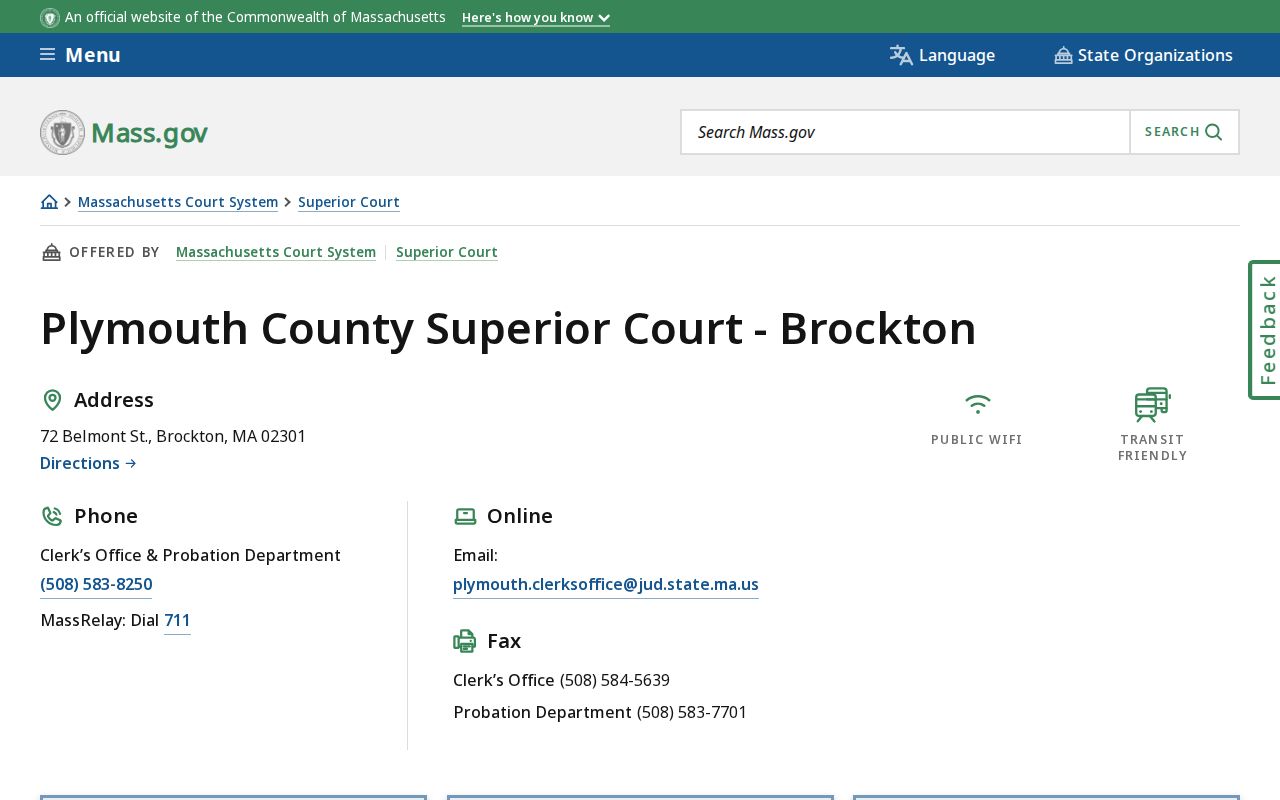
The Superior Court location page gives the clerk's office number, parking, and transit details. A District Court clerk cannot set a hearing on a Superior Court warrant. Those are separate dockets sharing one county.
How Warrants Get Served in Plymouth County
A criminal warrant in Massachusetts goes to an officer authorized to serve criminal process, and that officer may execute it anywhere in the Commonwealth. A local police department, a State Police trooper, or a deputy sheriff may each handle a Plymouth County warrant. Assignment turns on the case, not the county name.
City and Town Police
Local departments enforce valid judicial warrants. Plymouth Police policy states that the department enforces criminal judicial arrest warrants issued by a court.
Massachusetts State Police
Statewide enforcement, including the Violent Fugitive Apprehension Section for serious cases.
Sheriff's Deputies
Field services and Civil Process from 24 Long Pond Road. Civil service is not criminal warrant recall.
Because assignment varies, a police department may not know the current status of a case it never filed. The Plymouth County clerk always does.
Plymouth County Arrest and Search Warrants
News stories often lump the two together, but arrest warrants and search warrants do different work. An arrest warrant targets a person. It commands an arrest and a return to court. A search warrant lets officers search a person, place, or property on probable cause, and the supporting affidavit and application stay sealed until the warrant is returned. That seal explains why a search warrant served in Plymouth County produces no public record the next week. Note: reading that police executed a search warrant tells you nothing about whether an arrest warrant exists for anyone.
Arrest Warrants, Summonses, and Bench Warrants
Three documents, three problems. A summons is a written notice to appear. An arrest warrant authorizes custody on a charge, while a Plymouth County bench or default warrant grows from a missed court obligation.
| Document | What It Means | First Step |
|---|---|---|
| Summons | Notice to appear on a charged offense without immediate arrest | Appear on the date, or consult counsel about a rescheduling |
| Arrest warrant | Authorization to take a person into custody and return them to court | Call the issuing clerk and a lawyer before any appearance |
| Bench or default warrant | A court obligation was missed or left unpaid | Ask the clerk about default removal and recall |
If the notice does not say which one it is, the docket number settles it. The Plymouth County clerk reads that label in seconds.
Plymouth County Warrants Versus Federal Warrants
A federal warrant never shows up in a Plymouth County court file or on any Massachusetts docket. Federal process comes from a federal court, and the U.S. Marshals Service may enforce it.
Federal dockets live in PACER, which needs an account and may charge for documents; sealed warrant material may not appear there at all. The U.S. Marshals district page covers the enforcement role without a public name search. Read the letterhead first. A state case number points to a Massachusetts clerk. A federal case number points to federal counsel, not a Plymouth County clerk.
Handling an Arrest Warrant in Your Name
An arrest warrant does not expire on its own. It can be executed at any hour. That is why planning beats waiting in Plymouth County. Counsel can confirm the docket, ask the court what a voluntary appearance would look like, and lay out the realistic custody risk.
Important: Contact a Massachusetts defense lawyer before turning yourself in, and ask whether the court will set bail, conditions, or a scheduled session.
- Identify the issuing court, the division, and the docket number.
- Call the clerk and ask what the court requires and whether counsel may appear instead.
- Ask whether bail is already set and whether a judge must decide release.
- Bring identification, the notice, and anything showing the person is not the subject named.
- Ask how the recall or next appearance will be confirmed in writing, and keep that record.
If someone else used your identity, Massachusetts has you appear and ask the court to recall the warrant. It cannot be done by telephone. The county warrant overview collects the court contacts you need for that conversation in Plymouth County.
Plymouth County Arrest Warrant Bail Rules
In Plymouth County, bail gets sorted out after an arrest. That happens at the arraignment or through the court's release process. A judge has three basic choices: a cash amount, release conditions, or release on personal recognizance. The state's bail conditions page walks through how each option works. Ignoring a warrant makes things worse, though. A failure to appear after release can bring its own penalty. A money default can pile the amount owed on top of the bail requirement, and probation warrants may not be bailable at all without a judge. An outstanding warrant can also reach beyond the court, since licenses and state benefits can be affected. When you call the Plymouth County court, ask what closes the case, not just what opens the door. A confirmation of recall in writing is the paper that ends the worry.